Thomas Herrera, Finance & Global Business Senior, TCU

“TCGIF Spotlight” was created as our platform to recognize and provide exposure to our friends, clients, colleagues and team members both professionally and personally with simple, fun, entertaining and thought-provoking questions.
"I am committed to prioritizing my early career experience as I establish my professional path. I want to immerse myself in a relationship-driven industry, where personal connections and meaningful conversations hold as much value as financial metrics."
Panther Den Competition: The Panther Den Competition is a standout experience in your background. What key lessons did you take away from that experience, and how has it shaped your approach to real estate and investing?
The 2025 Panther Den competition tasked our team of seven to compile a slide deck and proforma for our development proposal for the LinQ site in Mansfield, Texas. We had a month to meet and discuss ideas while getting tips from experts in various fields such as engineering, architecture, entitlements, presentation coaching and finance. The first key lesson I took away from the competition was the importance of team dynamics and balancing team strengths. My more experienced teammates were more involved behind the scenes but thought it would be better for me to help present our project because I could convey more enthusiasm and confidence.
The next key lesson I took away from this experience was understanding all the ins and outs of the development process required to propose new Real Estate projects. Our team had to navigate zoning laws, gas lines, utilities, traffic flow, a sizable floodplain and the nearby developments before we could even begin to come up with ideas. Then when it came to proposing retail, hospitality, industrial and office features, I was able to learn how the rules for each differ. Costs between them will vary, and square footage matters more because their functional purpose within our development is unique. The final key lesson I took away was the importance of projecting enthusiasm when it came to the presentation. While connecting with many experts and judges, I was told that an idea is only as good as a team can sell it. We had to know our presentation backwards and forwards but also project a sense of excitement to make our development stand out from the rest.
This experience will forever shape my approach to real estate by instilling an excitement for how I can use my skills learned in undergrad to help a team project. It showed me how to navigate problem-solving and appease all the stakeholders involved in a real estate development. It taught me about investing by learning what certain communities value and where the population growth in North Texas is trending. Overall, Panther Den conveyed to me how important people are, above everything else, in any sort of real estate transaction. Fostering those relationships and building connections is how to turn visions into reality.
Commercial Real Estate Class: Professor Hill’s Commercial Real Estate class is well-known at TCU. What were some of the most impactful takeaways from that experience, and how have you applied those lessons in your professional growth?
My very first takeaway from Professor Hill’s class was how real estate is a relationship business and the class was structured to reflect that. It is important to hold on to TCU’s connections and use these connections later in life. I was also blown away by how willing the guest speakers were to answer every question posed by students. They constantly told us that there are no bad questions in real estate and how important it is to ask questions of people more experienced than you. This also helped me learn various networking skills and how critical it is to follow up with every guest speaker that comes in to talk. Following up is more than just an email, it is a couple of emails, a hand written thank you letter and trying to meet up in person soon after the speaker came in. This helped launch my networking skills beyond just a simple conversation by making a conscious effort to get as much out of each speaker as possible.
I applied these lessons to my professional growth by focusing on professionalism, time management, and experience. My professionalism improved as I practiced introducing an esteemed speaker, Cary Tremper, who took time out of his day to help teach our class. This professionalism extended beyond the classroom as I reached out to most of the speakers separately and practiced using industry-specific real estate terminology I learned in class. My time management skills improved as Professor Hill and the many speakers gave valuable tips for what to focus our energy on before graduation. They also showed us how to concisely fit a certain real estate topic into a short one hour class period while getting to every question posed by students. The final benefit to my professional growth came when the guest speakers shared career advice. Many would emphasize the importance of experience over money and how that would pay more dividends in the future. Additionally, the speakers taught me to look for strong leaders, good financials, good culture, and rewarding work when considering a company to work for. Overall, this class helped me build so many new connections, ignite my interest in real estate finance, and get me excited for what's next in my career.
Keiretsu Forum Internship: During your internship with Keiretsu Forum, you evaluated company pitches alongside accredited investors. What strategies did you develop for assessing risk and identifying strong investment opportunities, and how has that experience influenced your long-term career goals?
I was incredibly thankful for my time with Keiretsu Forum during this school year. I gained firsthand experience in assessing risk and identifying strong investment opportunities. The first lesson I learned when assessing my first few companies was the importance of ROI and an exit strategy. Many companies approach the opportunity to pitch by diving deep into their business model and core focus. However, they focus all their energy on the business model rather than how investors can make their money. The exit strategy is the key to investors recouping their money and while the business model is important, it is not the most important factor for angel investors. The importance of the exit strategy also ties into the ROI predictions that help convince investors whether the opportunity is worth pursuing.
The next lesson I took away was the importance of enthusiasm when presenting an idea because a company is only as good as its ability to sell itself. I came to notice the importance of people over the product because dealing with these companies at the forum or during due diligence required a lot of teamwork. The strongest investment opportunities are typically led by those who are the most transparent about their numbers and have a large enough team to handle the company’s full operations. Another reason why people became such an important theme was the grading process, where many categories were assessing the team, the advisory board, the grasp of the competitive space and their intellectual property.
This experience influenced my long term goals by showing me the early stages of businesses and how they use angel investing for various expenses whether it's R&D, marketing, manufacturing or expanding the team. It gave me an expansive look into how CEOs balance finance, marketing and management to sell a product not only to customers but also to investors. The skills and knowledge gained from this can apply not only to my full time career but also to my personal investment journey if I choose to invest in earlier stage companies later in life.
Global Business Insights: How has your background in global business - including your coursework in international politics and foreign policy - influenced your perspective on real estate and investment strategy?
The first way I have seen my global business minor coursework connect with my professional experience is through the investment strategy in my internship. Many of the companies that pitch are foreign companies or are looking to expand into foreign markets. My knowledge of the European market compared to the American market has given me a unique perspective when asking questions for these companies. Understanding the political culture and history that influence global markets has allowed me to draw meaningful connections with investment strategy and identify the markets with the highest potential. This directly connects to my International Finance class where we discussed the importance of diversifying investments with foreign assets and how to mitigate the risks that come with this strategy.
From a real estate perspective, I have gained insight into how U.S. foreign policy affects the industry, even when policies primarily exist in the government space. I have learned how real estate markets are inherently tied to foreign policy actions such as tariffs, interest rates, trade policy, immigration and global investment in American assets. The cultural, social, and historical knowledge of global markets that I gained from this coursework has helped me understand why countries act the way they do and how their economic and business strategies evolve. The U.S. real estate market will always be interconnected with global events and foreign investment influencing costs, strategic decisions and growth opportunities. I am grateful that I was able to diversify my course load to develop a strong foundation in global business, allowing me to bring that perspective to a company in the future.
Future Goals: Looking ahead, what excites you most about your career path in commercial real estate, venture capital, or sports management?
As I look ahead in my career, what excites me most is the opportunity to connect and engage with driven professionals in real estate and finance. I experienced this firsthand during my Panther Den Competition and I want to leverage these connections to find a role where I feel valued and fulfilled. I am eager to join a company with the right culture fit where my skills can thrive while also making a meaningful community impact. My degree from Neeley provides a strong foundation, allowing me to explore various fields while remaining in the Texas market. Overall, I am committed to prioritizing early career experience over money as I establish my professional path. I want to immerse myself in a relationship-driven industry, where personal connections and meaningful conversations hold as much value as financial metrics.
Frog Army & TCU Athletics: As an active member of Frog Army, what has that experience taught you about leadership, teamwork, or building connections on campus?
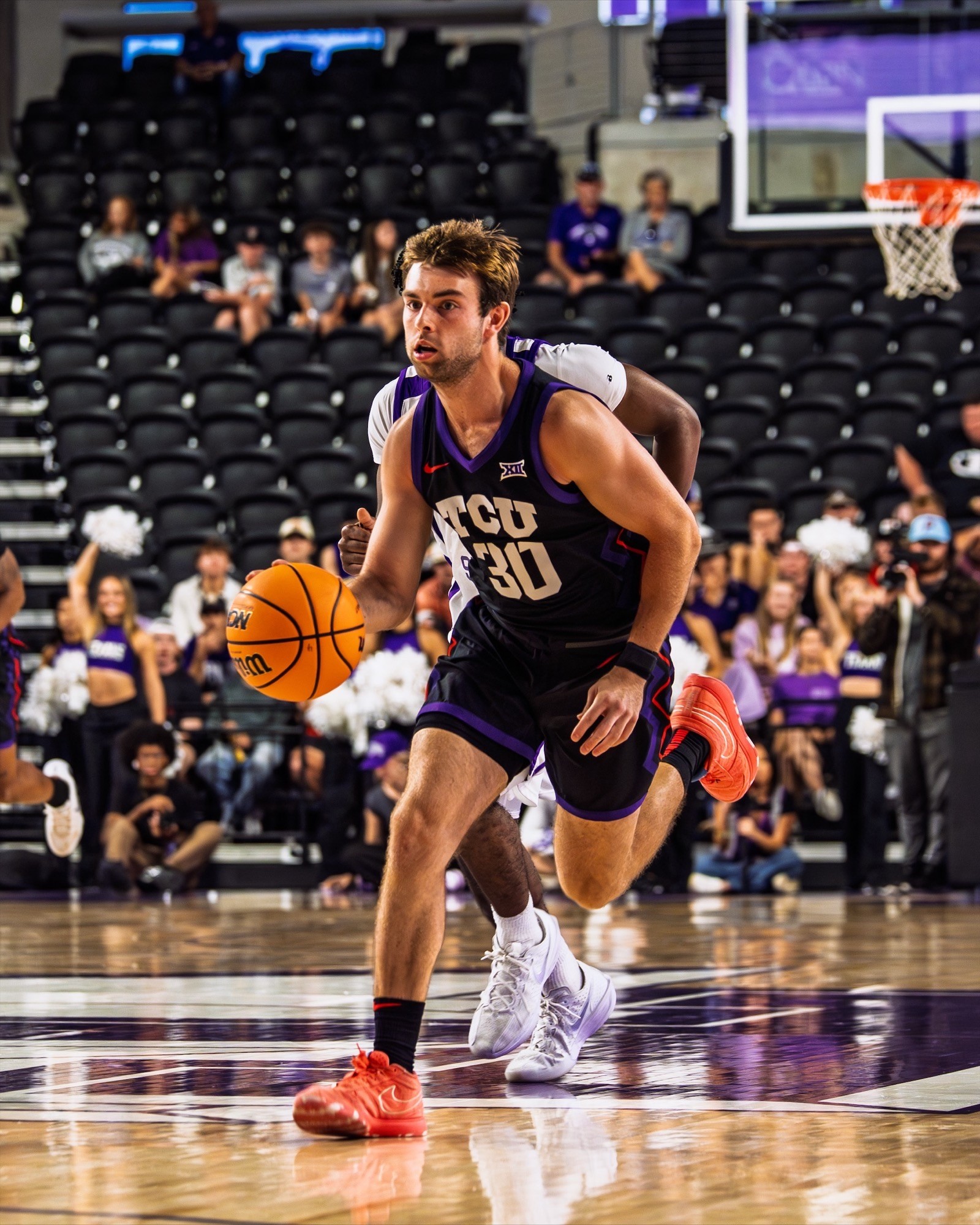
My involvement in Frog Army has shown me that passion for sports transcends the game itself. It has helped me step out of my shell and take a front-and-center role at every game, embodying the energy and enthusiasm needed to support our team. Frog Army unites the student body through amplified school spirit, creating an electric atmosphere in the arena. Showing up early and staying after TCU basketball games has transformed these games into an immersive experience. Frog Army has taught me the teamwork and planning required behind the scenes to be ready for every home game. It has given me the opportunity to apply marketing skills I learned in my Neeley core classes to build student engagement for the games. The unique marketing platform allows me and other students to brainstorm creative ideas to fill seats from giveaways and tabling, to social media and word of mouth.
Beyond the marketing aspect, Frog Army has allowed me to build connections within the TCU athletics department and with some of the athletes. This superfan group helps bridge the gap between popular players and fans, making the experience more inclusive for everyone. It was a dream of mine to step onto the court and talk with future professional athletes about their TCU experience. Through Frog Army, I had the chance to gain first hand exposure to my longtime dream career path in sports management.
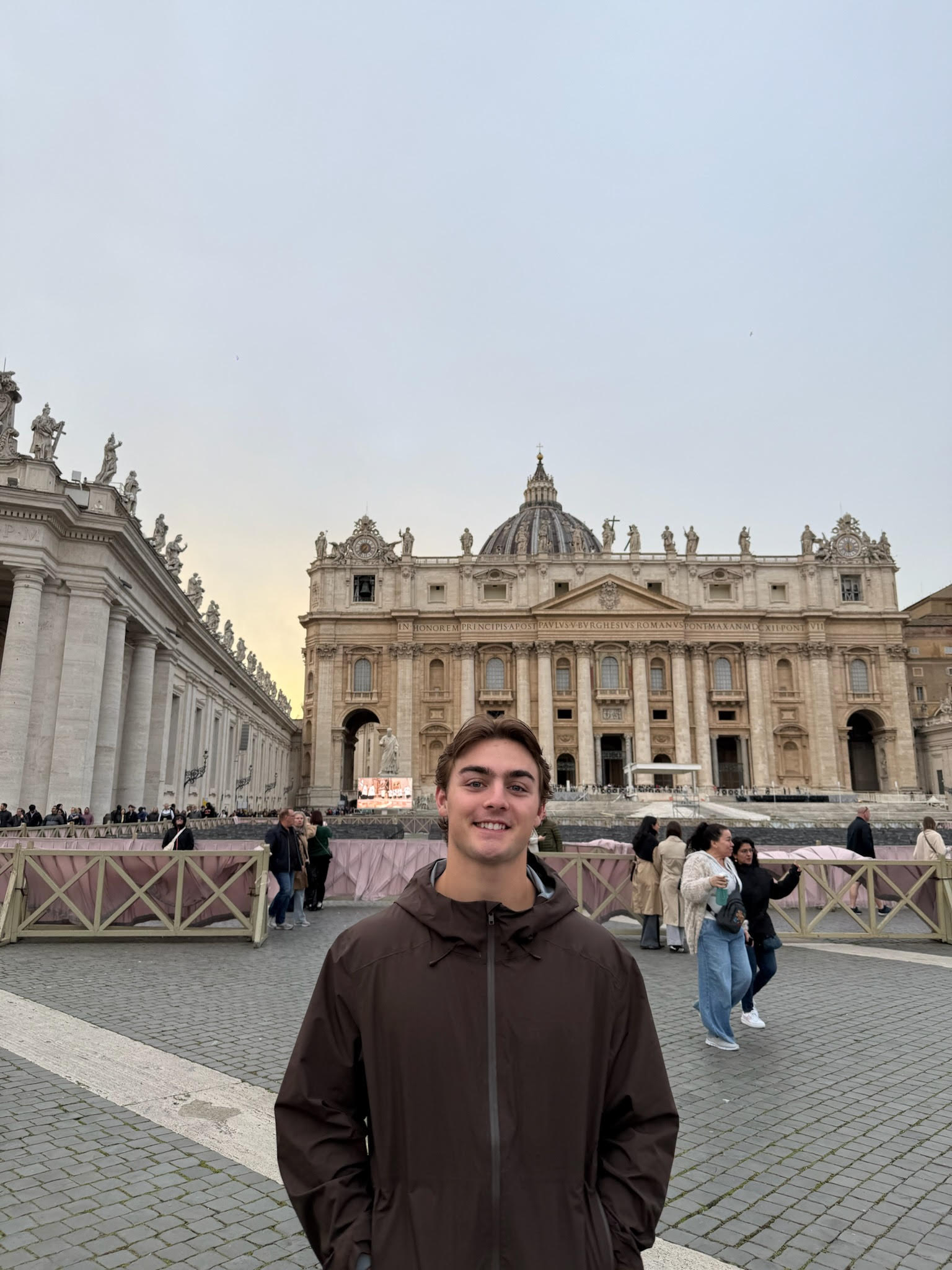
Study Abroad in Rome: Studying abroad in Rome must have been a transformative experience. What cultural insights or personal growth moments from that trip have stuck with you the most?
What stuck with me the most in my study abroad experience was how Italy was more than just a tourist destination. It has a historically rich culture that differs from region to region. I learned how its physical, political, and cultural geography have been shaped by the Romans to the Papal States to its present form as the Republic of Italy. I was introduced to Roman food culture, which prioritizes relaxation and mindfulness when getting together for meals. It was interesting to see the clash between globalization and industrialization with the traditional culture that many Italians hold dear to their identity.
I enjoyed seeing how impactful the game of soccer is beyond the pitch. Everyday, I would walk to class or tour the city and see street vendors selling jerseys. I went to a Lazio game and the energy was unlike anything I had ever seen at an American sporting event. I was able to join in on this wave of soccer excitement by buying some jerseys instead of the typical tourist souvenirs. The coolest moment of the trip was experiencing the hype on the streets during the Europa League Final which featured hometown team Roma against Sevilla. The game brought the city to life and embodied the power of sport in a way I could have never imagined.
My personal growth from the trip was evident in my new ability to be comfortable in an uncomfortable setting. I was taking classes in the summer at a foreign school while trying to balance learning about the culture of Rome. It reinforced the importance of traveling as a way to immerse yourself in the people rather than view countries through the lens of tourism. This whole experience served as a way to magnify my TCU experience by taking me from the classroom to a foreign country. I will never forget the memories and people I met along the way.
More News & Insights

TCGIF Spotlight Series
•
7/1/26
TCGIF Spotlight Series
•
6/12/26
TCGIF Spotlight Series
•
4/24/26